

I don’t say this often, but Pixar is my favorite. Whenever folks ask me to choose between Disney or Pixar, I always say Pixar. This isn’t to say that I don’t like Disney movies. While I enjoy fairy tales, I always preferred stories with personal touches. Even as a kid, I always thought something more personal and relatable was being offered in Pixar films.
That leads me to Turning Red. To be honest, I have yet to watch this movie. I’ve heard some decent things about it, but I don’t have a definitive opinion at the moment. All I can say is that the animation looks great and the story sounds cute. A simple yet effective allegory for puberty in modern day. I’ve seen some disappointing modern Pixar films, but they can occasionally release something in line with their previous master works.
Usually when it’s a sequel to an old hit, it’s mediocre at best with hints of good elements. At least in my experience. Although, original Pixar ideas today can still be well thought-out with a lot of passion. It’s possible it could be the same with Turning Red, but that remains to be seen. To any of y’all who’ve already seen it: no spoilers! That’s my job! Without further ado, let’s dive in.
Let’s pop those pimples and trim that fur in Turning Red.
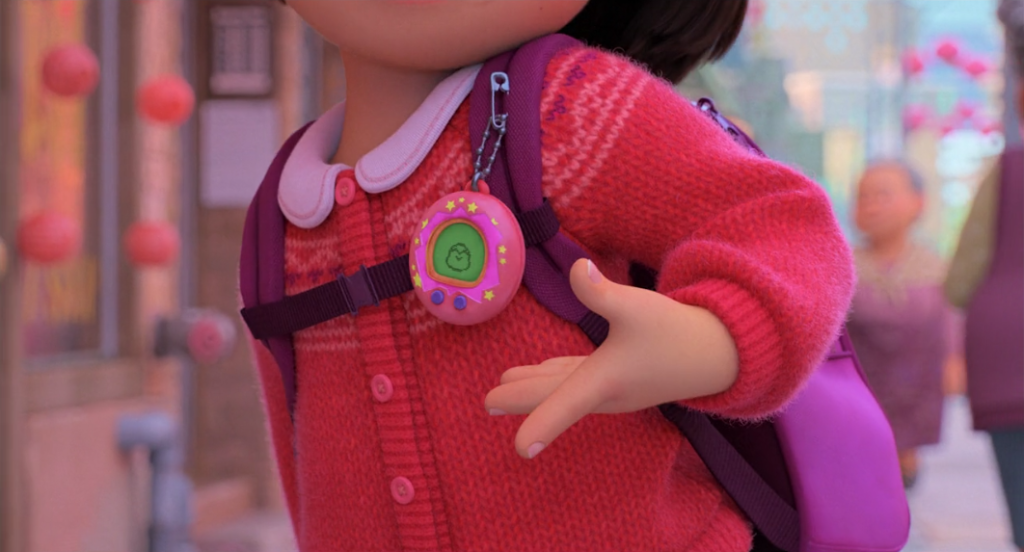
Before I go too far, I’d like to mention the first thing that jumped out at me. As a kid who grew up in the 2000s:


Another thing I enjoy is the fast-paced intro style. It jumps around pretty frequently, but in a visually pleasing way. To me, it gives it a Scott Pilgrim kinda vibe. What helps is that the movie doesn’t constantly throw things at you. This is just to get the intro out of the way. It also establishes the point of the film early on.
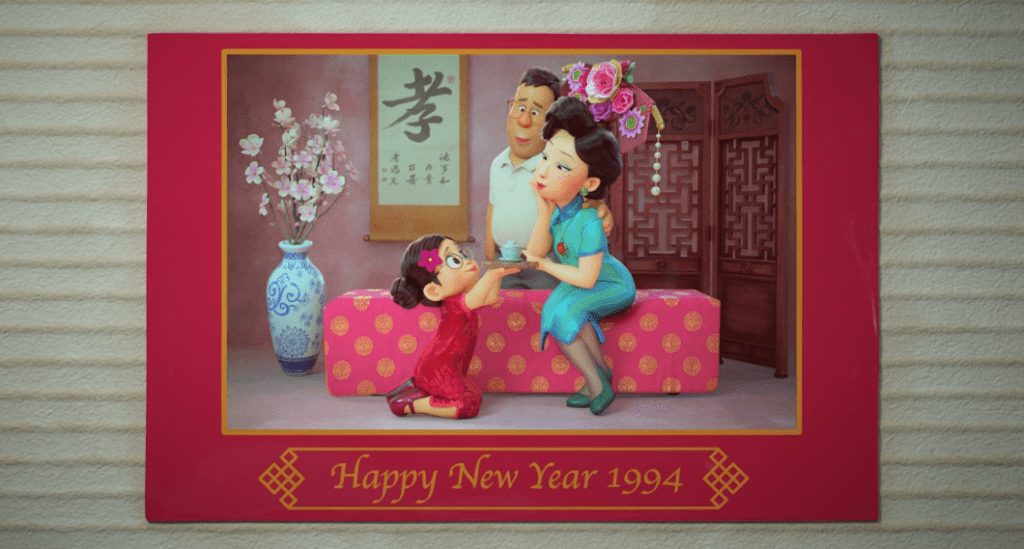
It makes it clear from early on that this movie is going to be a tight-knit and family oriented feature. Oh boy, it also introduces complications pretty soon. These complications also remain ever-present throughout the film’s runtime. Protagonist Meilin Lee (voiced by Rosalie Chiang), has a close relationship with her parents. Particularly, her mother: Ming Lee (voiced by Sandra Oh).
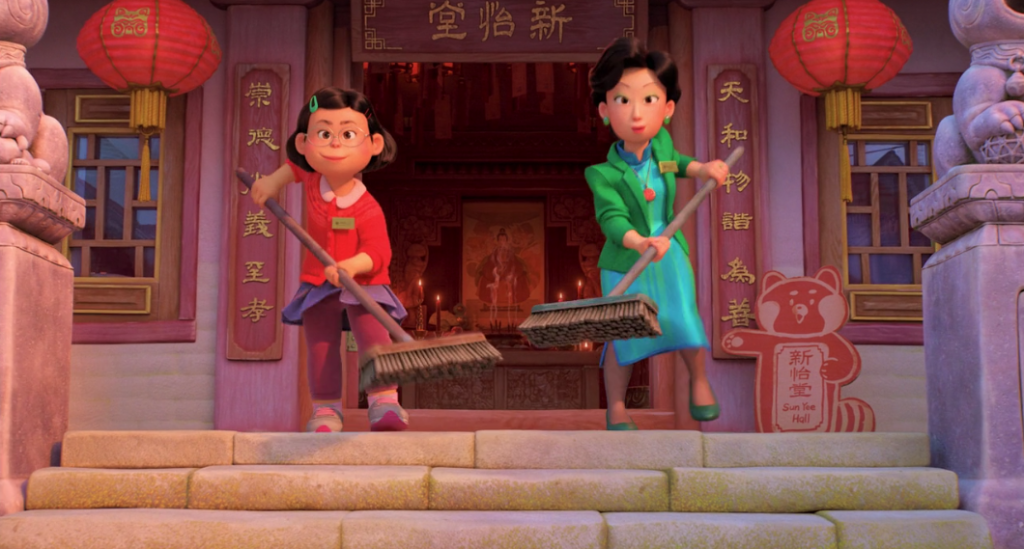
The thing about Ming (ooh, rhyme), is that she’s very protective of her daughter.


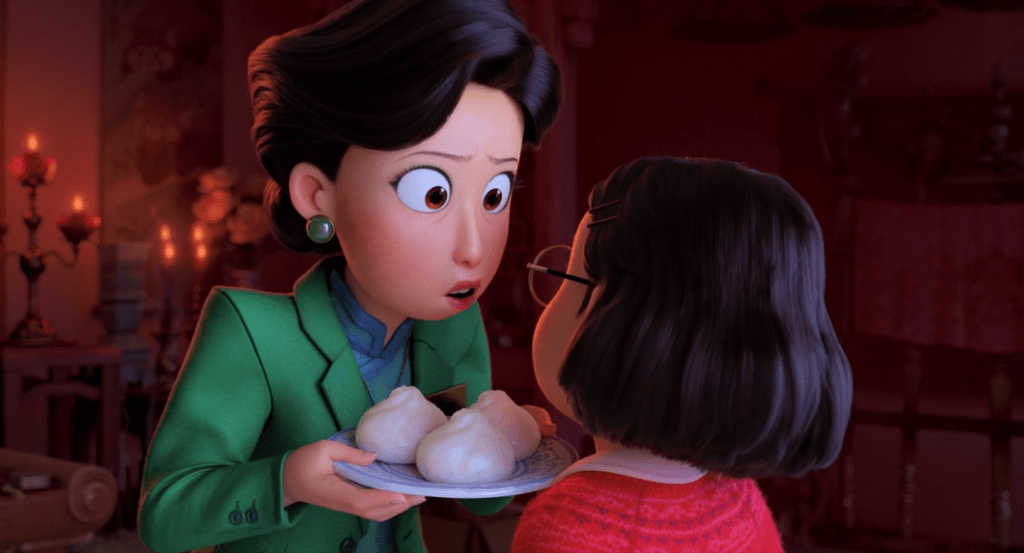
Maybe a bit too much.
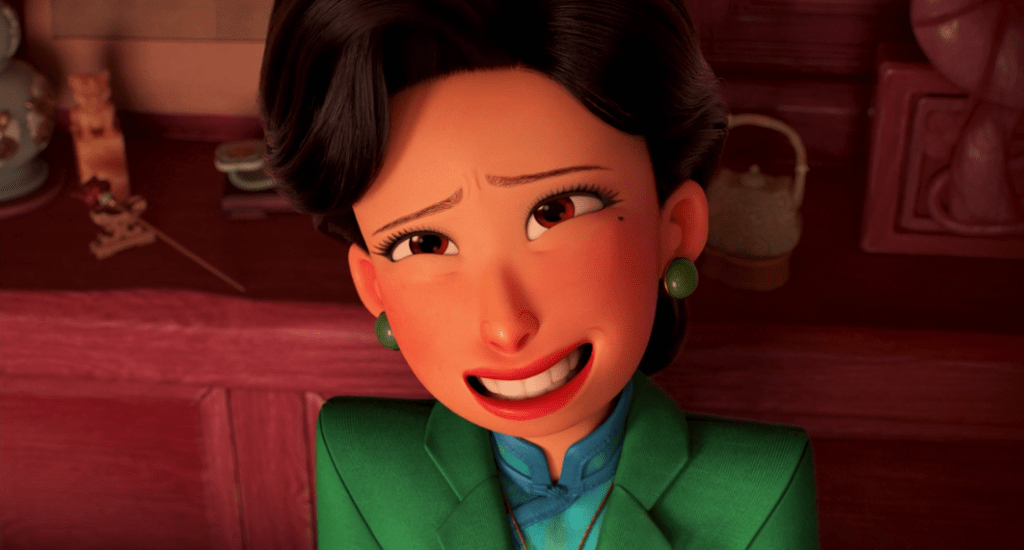
Like Marlin from Finding Nemo, you can understand why a parent would feel this way. The difference between Ming and Marlin is how their characters are developed. In Marlin’s case, they tell you up-front why he is the way he is. With Ming, however, the movie doesn’t go into detail about it until later. Because of this, Ming can be a bit overbearing at times.


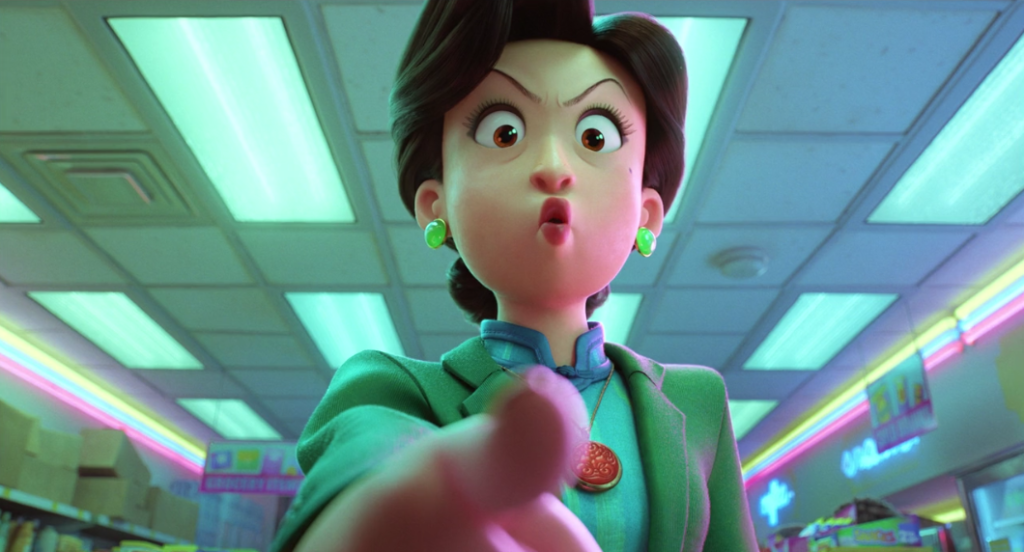

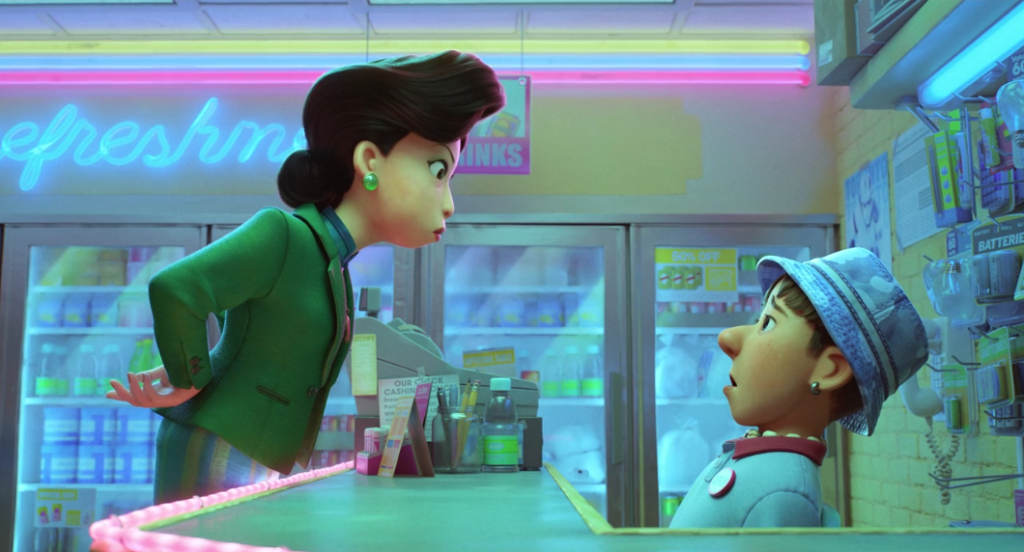


Heck, I’d probably die of embarrassment on the spot.
As you can see, Ming is a lot. Like Marlin, they help balance out her annoying tendencies with comedy like in the images I shared. If you’re laughing at her nonsense, it helps you take your mind away from how invasive she is. Because she is invasive. Although, that’s not all she is. Both her and Mei also share some genuinely heartfelt and personal scenes.
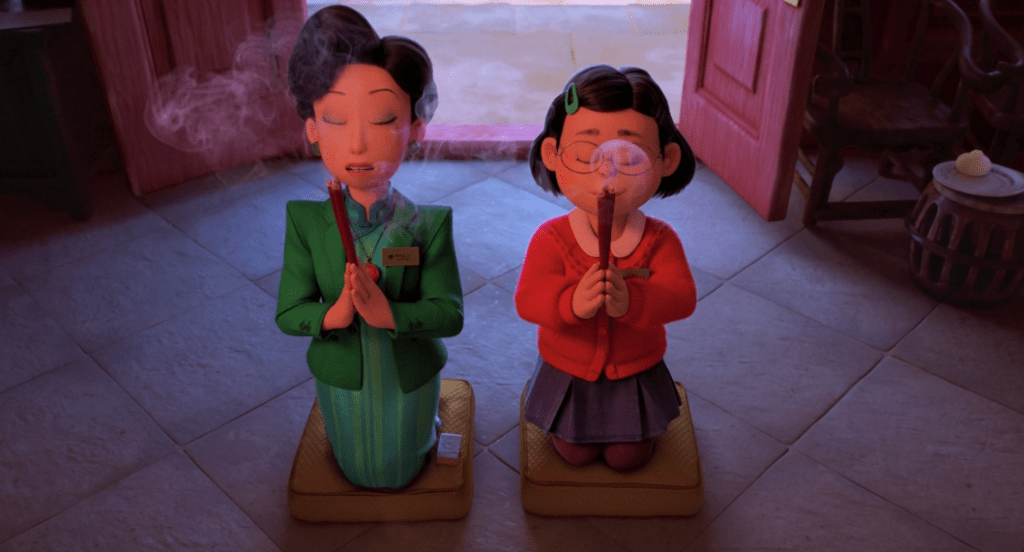
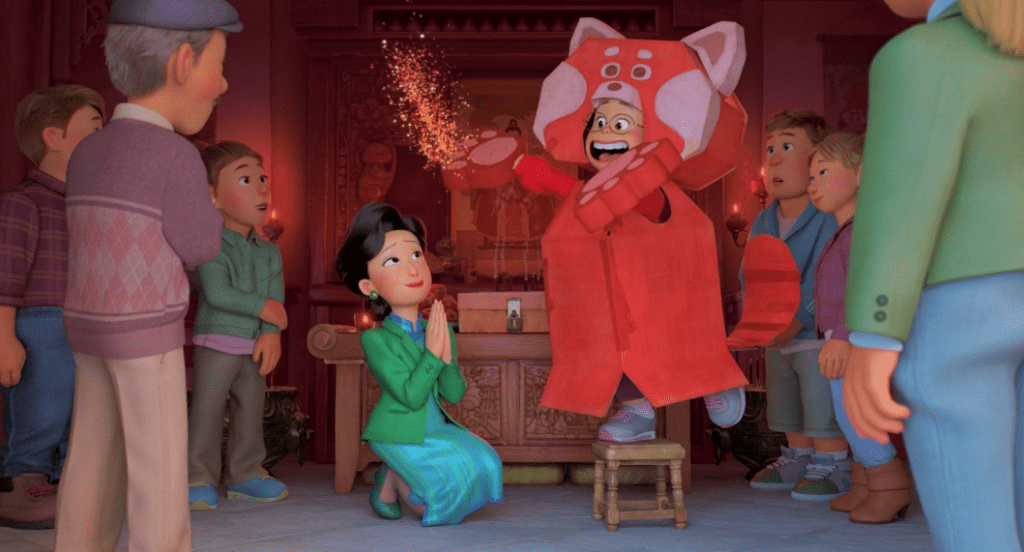

The movie does a good job of depicting its characters as three-dimensional. Where complications arise is when Mei and her friend group learn of an upcoming concert. Their favorite band is playing in their home town of Toronto. They wanna go. Really really badly.
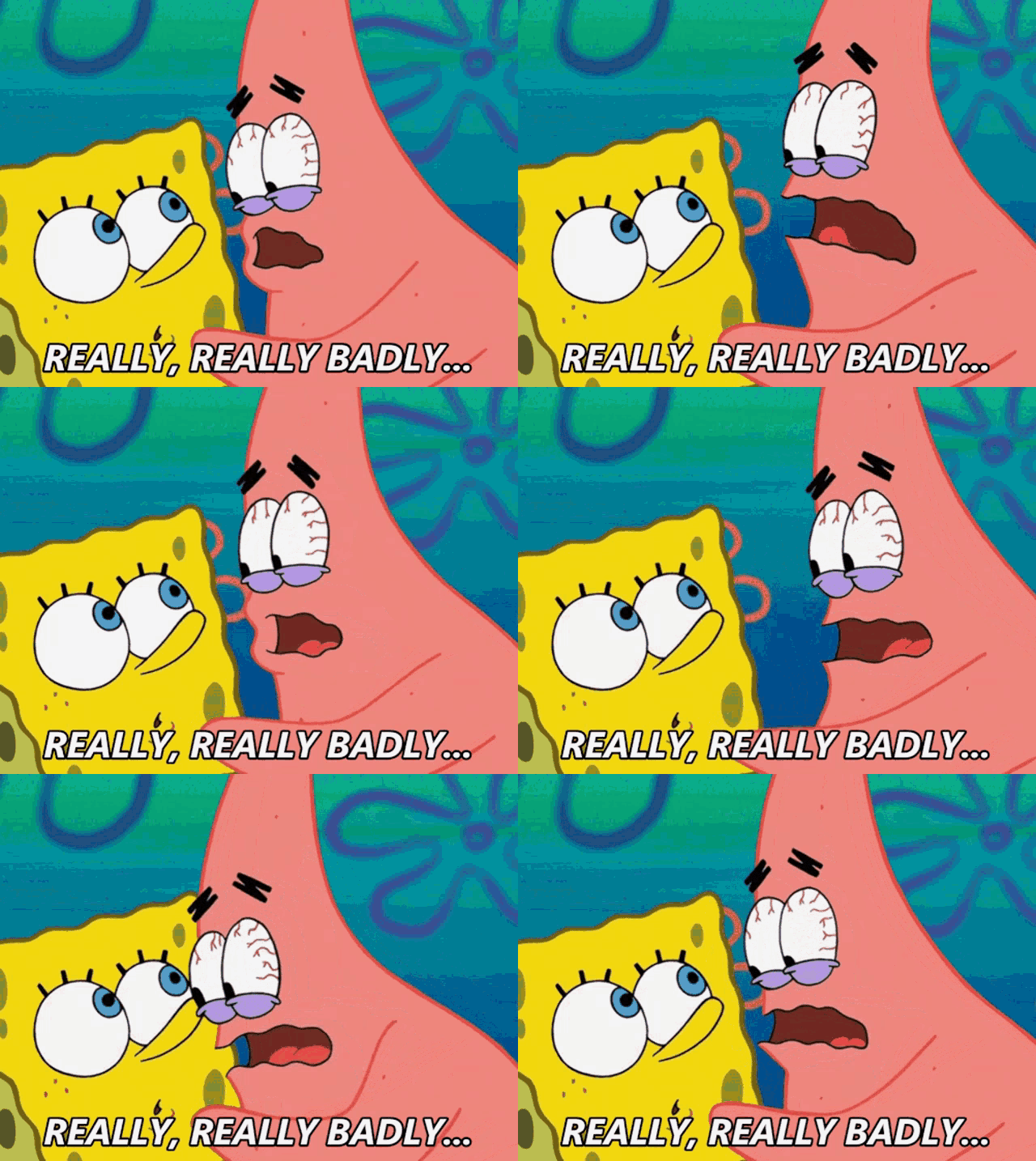
Given their general vibe, I’m not surprised. Also, let’s talk about them real quick.

There’s Miriam (voiced by Ava Morse) –

– Priya (voiced by Maitreyi Ramakrishnan) –

– and Abby (voiced by Hyein Park).

Miriam is the “delinquent” one so-to-speak. Ming sees her as a bad influence on Meilin and doesn’t approve of their friendship. Priya is the cool one who’s always calm and measured. She has a great deadpan sense of humor. Lastly, Abby is the hyper-energized one constantly bouncing off the walls. Together, they make a pretty nice quartet and play off of each other well. Mei seems to think so too, which introduces the main issue of the movie:
Who does Meilin love more: her family, or her friends?
‘Cause remember what she said earlier –
– but,
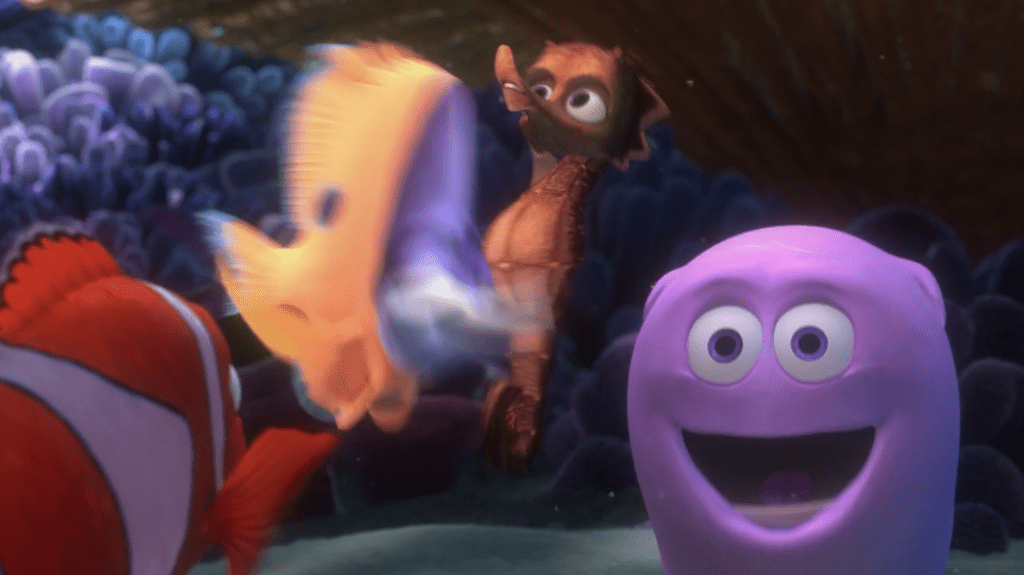
Okay, I’ll stop with the Finding Nemo references.
Maybe…
Either way, you see the bind Mei is in. It only gets worse when she turns into a giant red panda.
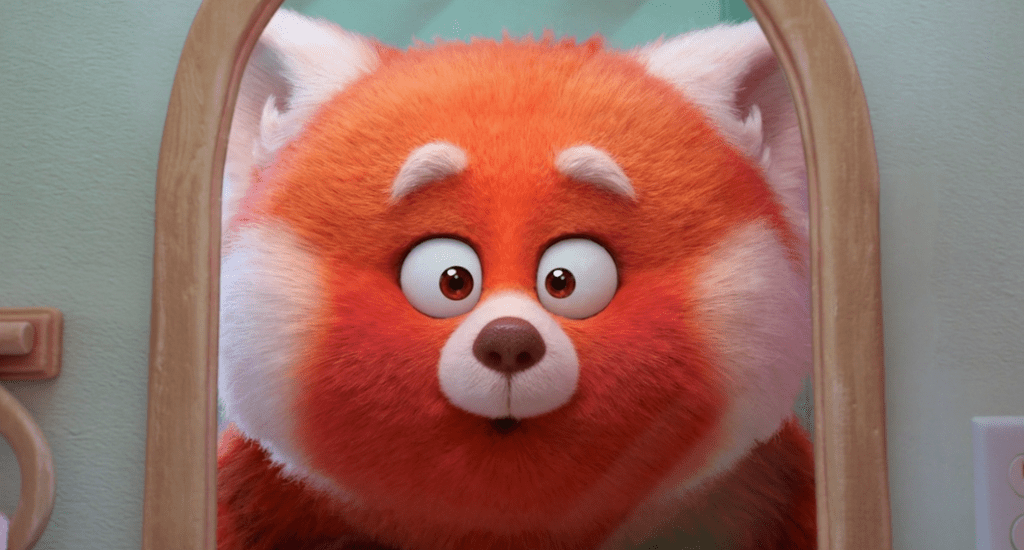
What’s the downside, really?
Maybe I’m just weird (or a furry), but I’d love to turn into a giant living plushie.
I would give hugs to all the folks I love!
I like hugs, and fluffy hugs are even better.
Also, this might be my new favorite euphemism for the onset of puberty:
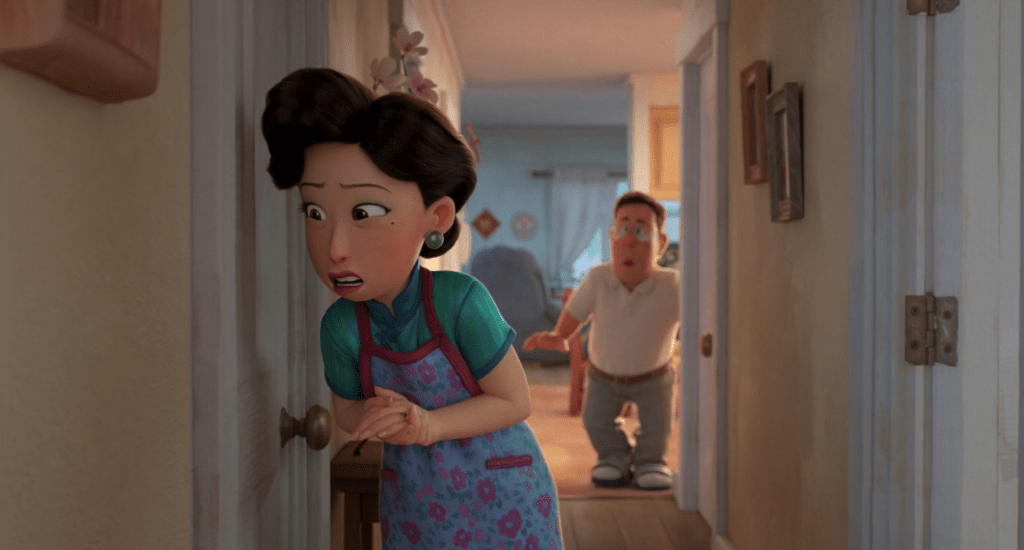
I’m totally stealing that.
From the beginning, the movie established that Mei has only recently turned 13. Because of that, you understand she’s at that age where she’s torn between her family and friends. There are several other coming-of-age films that have dealt with this concept. The key difference here being the addition of the giant red panda. The shenanigans Mei and her friends get up to are charming, but not the most original.
It’s pretty predictable coming-of-age fare. When compared to a film like Inside Out, they actually convey opposite ideas. Inside Out looks at growing up from an internal perspective (hence the name), while Turning Red looks at it externally. Most other coming-of-age films (and media in general) tend to view this concept from that perspective. Turning Red stands out by being the only Pixar film to do this. Specifically the external coming-of-age approach.

Why I see this as different is because Toy Story 3 looks at this concept from a third-person perspective.
I still like it all the same.
What I meant was that Turning Red views this idea externally and in first-person.
(The person going through the changes is the main character)
Also, it does it in classic Pixar fashion. The thing I was most worried about was the movie focusing too much on ideas and losing sight of characters. I’ve seen this done in some of their other recent productions like Incredibles 2, Finding Dory, and Monsters University. Instead of pushing their characters to the next level, they focus on wacky scenarios they can put those characters in. If the characters don’t grow, what’s the point of the movie?
Turning Red luckily doesn’t fall into that category. In fact, I think there’s a lot of heart put into it. For example, when Ming learns of Mei’s first transformation, she does everything in her power to repress it.

As soon as this secret about their family is revealed, it’s framed as a “bad thing.” I also enjoy the history around the red panda spirit being passed down in their family. It’s great contrast because what was intended as positive in one generation can become negative in the next. In one little story, it creates several layers of complexity for the film going forward.


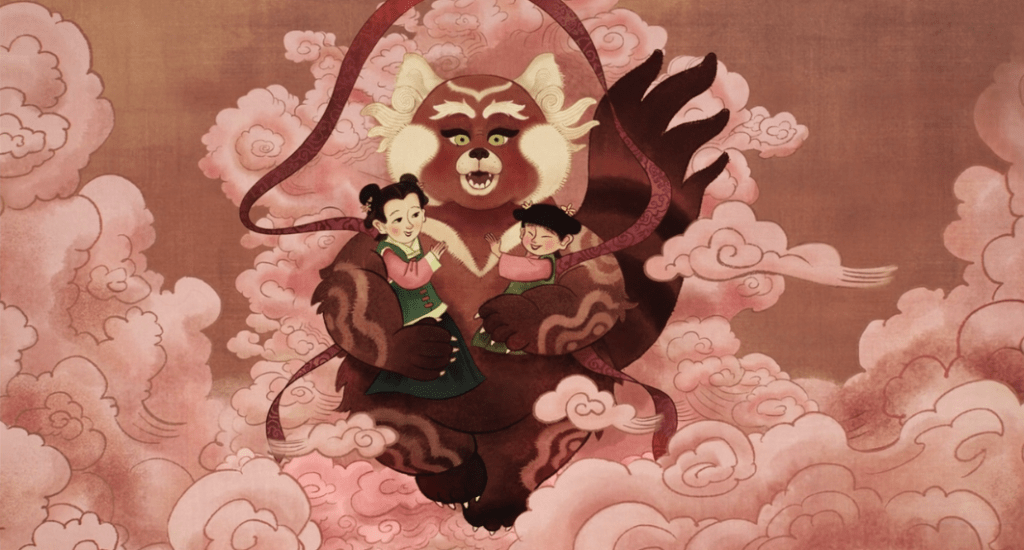

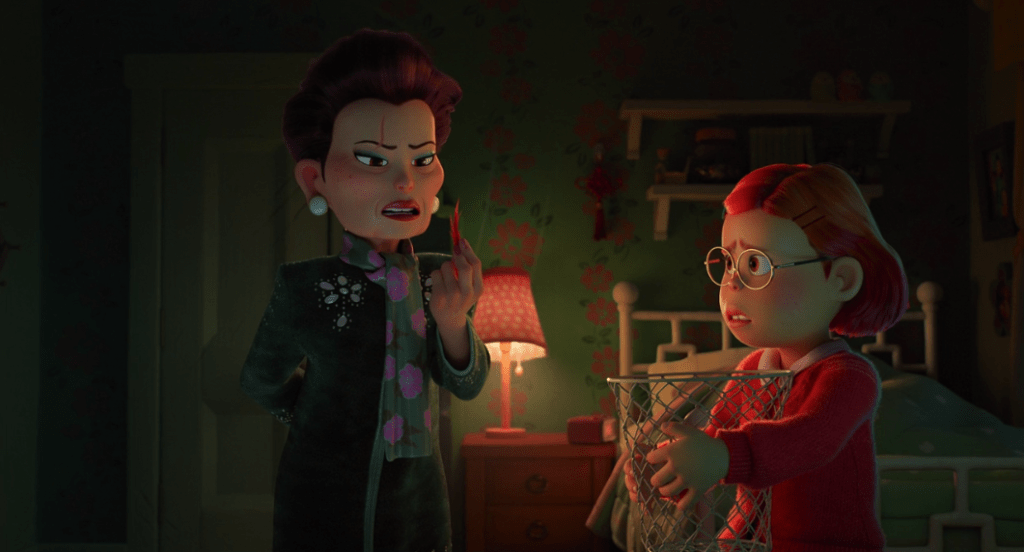
Even though the family understands the original intention behind the red panda, they talk about it very negatively. When Mei’s family comes to visit, her grandmother (voiced by Wai Ching Ho) all but confirms its beastly nature.
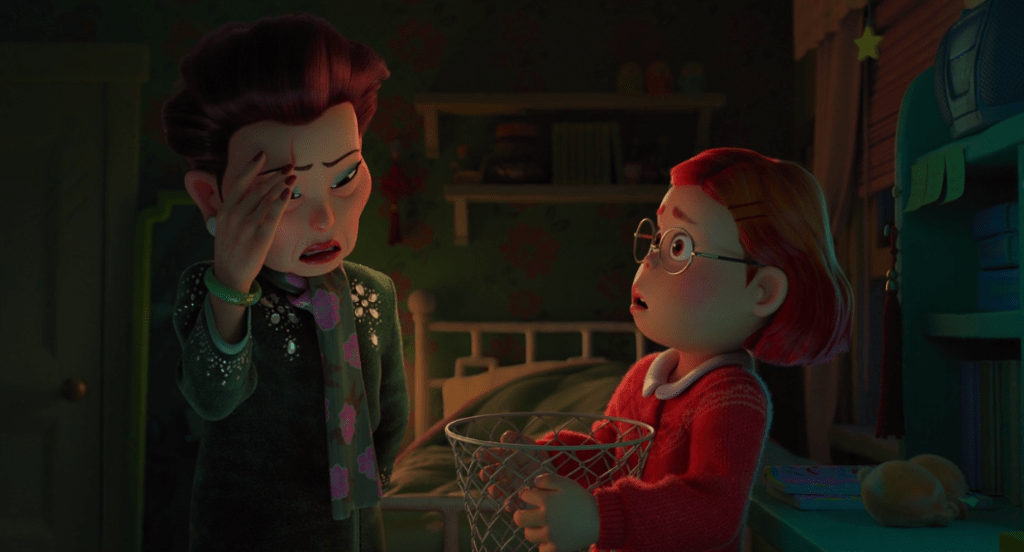

Although, during the majority of the film, we see scenes with Mei’s panda like this:
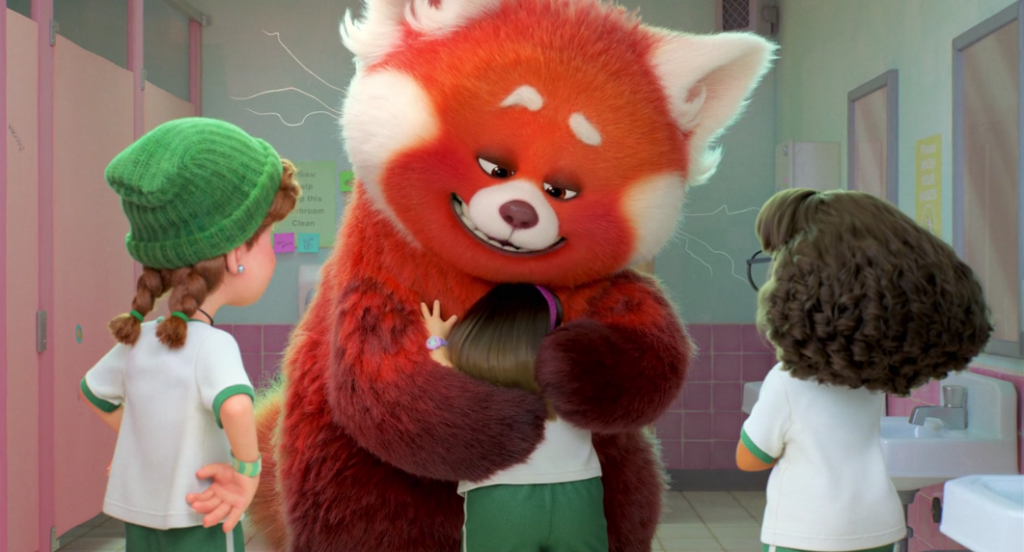


One of them just happens to be a giant panda.
There is, naturally, a key moment where Mei lashes out in panda form. When she agrees to panda at her arch-nemesis Tyler (voiced by Tristan Allerick Chen)’s birthday party, what could go wrong?

This scene does a good job at two things: sowing doubt in the panda’s integrity, and questioning Mei’s relationship choices. When I first saw this scene, I started wondering if what Mei’s family had been saying was true. Especially when this is the general reaction from everyone around them:
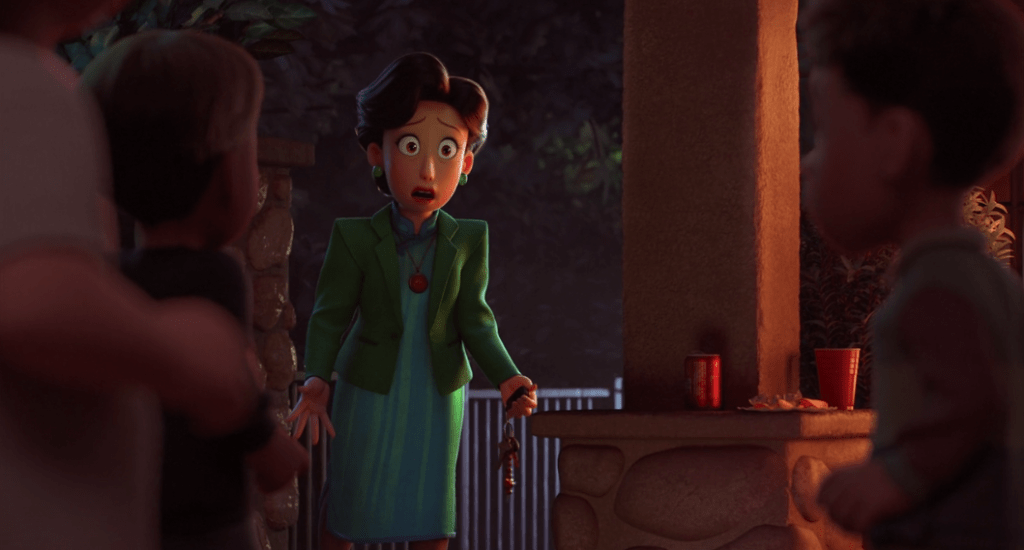


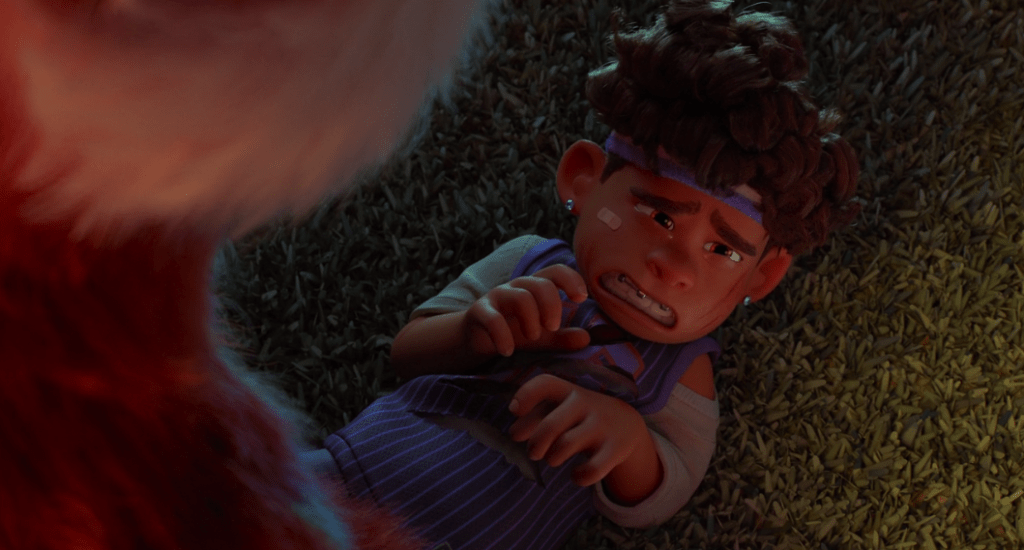
Ooh!
We have blood!
What’s this movie rated?

What’s in this that’s worth a PG?!
Was the pad joke too much for the kids?!
Right after this moment is when Mei’s loyalties are put to the ultimate test though. She’s forced to choose a side between her mom and her friends. Who does she pick?


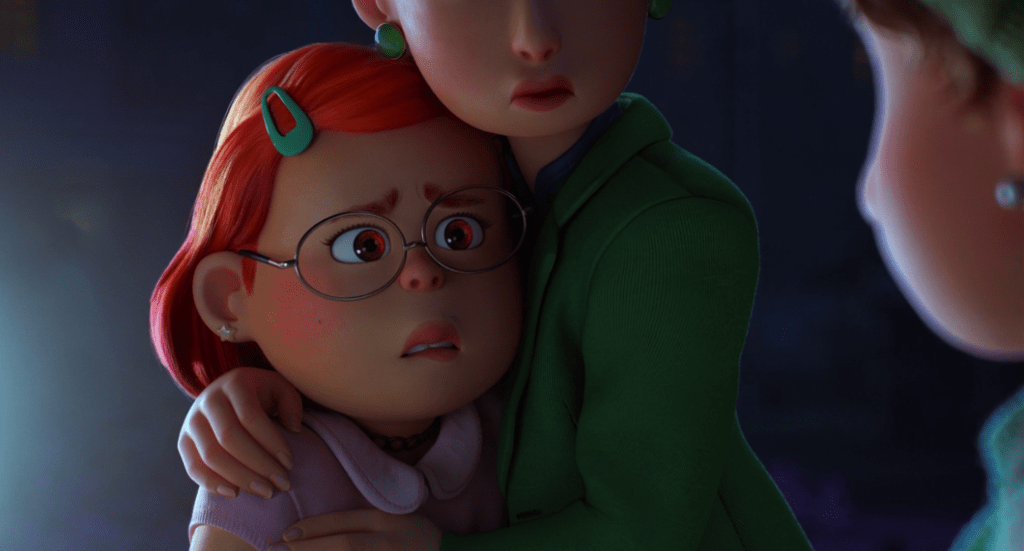

Although, when I was her age, if I was faced with a similar decision I would’ve done the same.
It’s not the right decision, but I like when movies still make characters’ bad choices relatable.
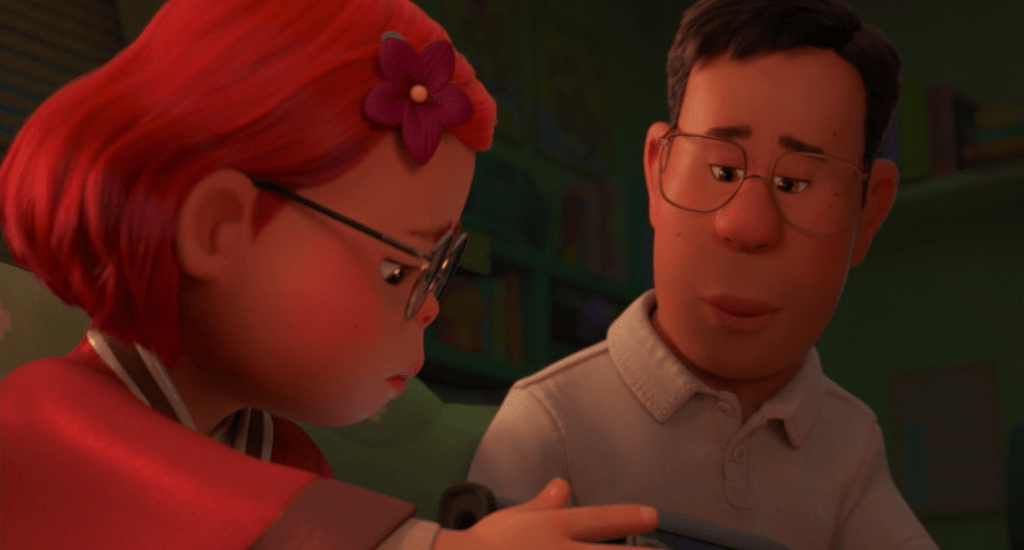
This leads to the banishing ritual that’s supposed to rid Mei of the panda. The same night as the concert. Before the ritual, I like the conversation Mei has with her father, Jin (voiced by Orion Lee). He talks to her about the good the panda can bring, how everyone has different sides to them. I also like that it’s specifically her father who has this conversation with her. Up until now he hasn’t done much, so it’s nice that they gave him an important role here.

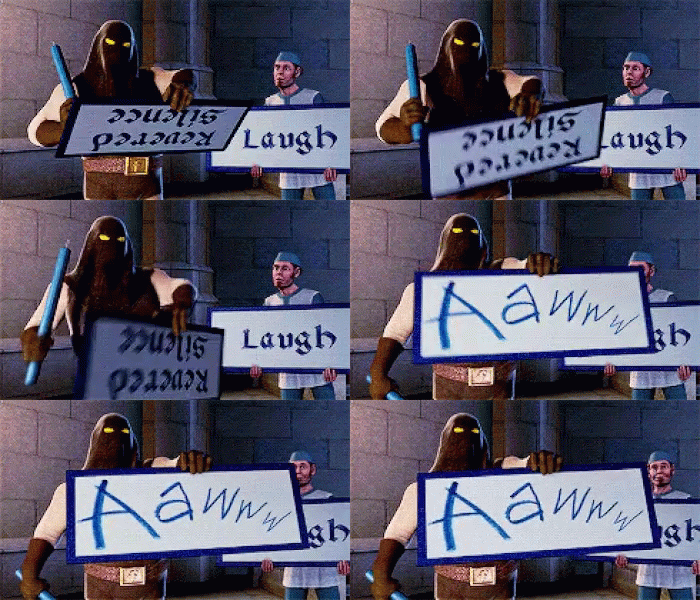
Great timing with the Shrek reference there, because Turning Red takes a page from their playbook. Instead of banishing the panda (like her family wants to) Mei decides to keep it. To everyone’s disMei. Heh heh, get it?
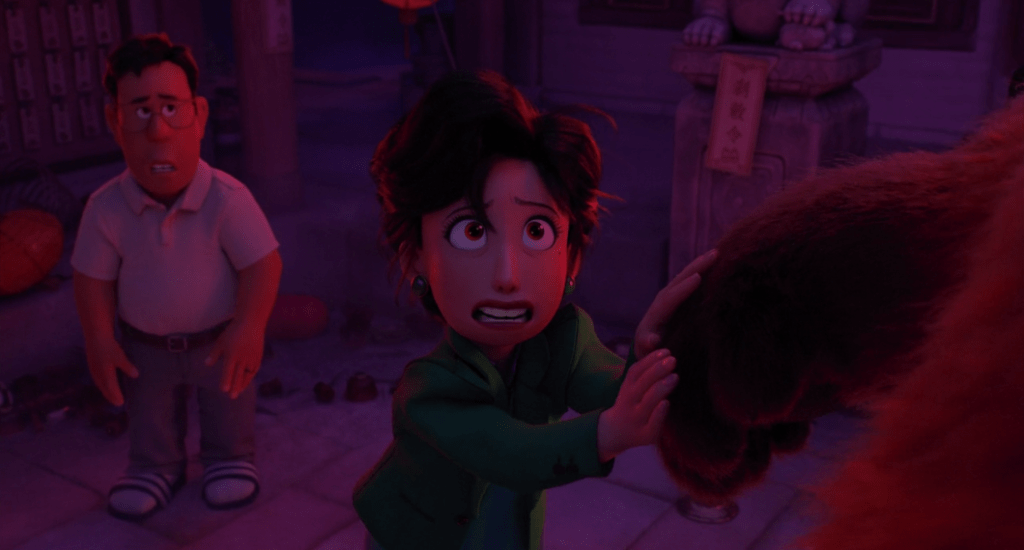
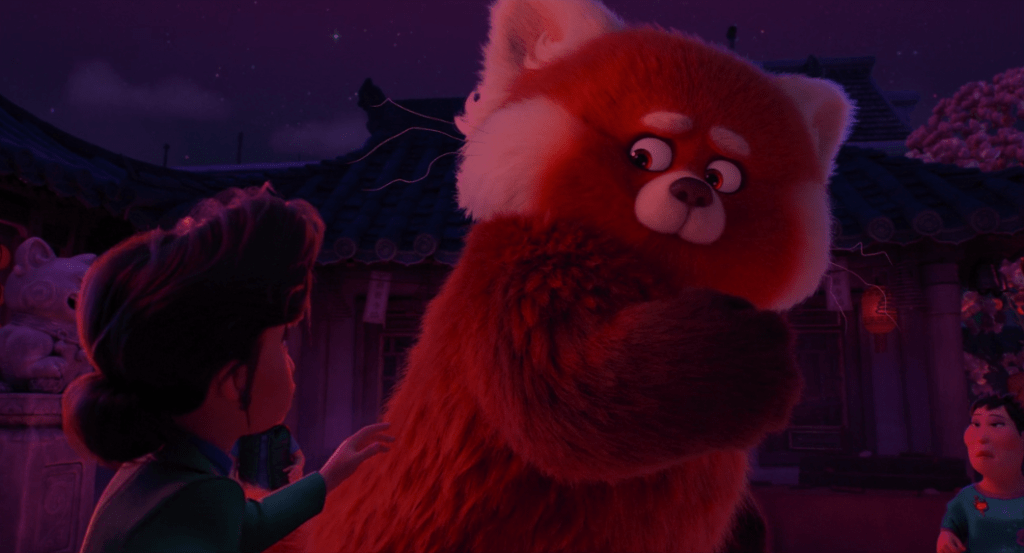

Oh snap!
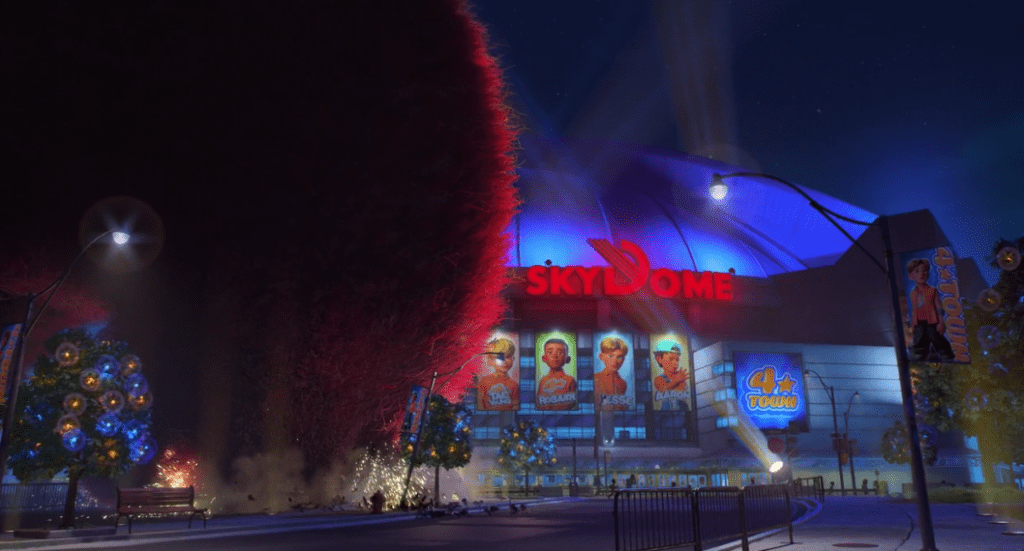
In the process, Mei abandons her family to go see the concert with her friends. Also, Ming gets so mad her panda is released. Uh-oh.

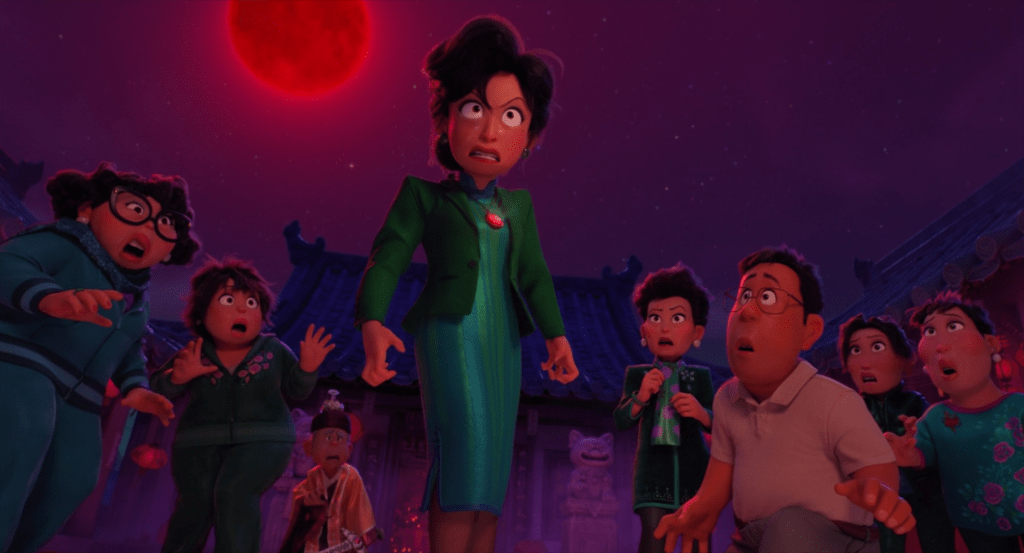
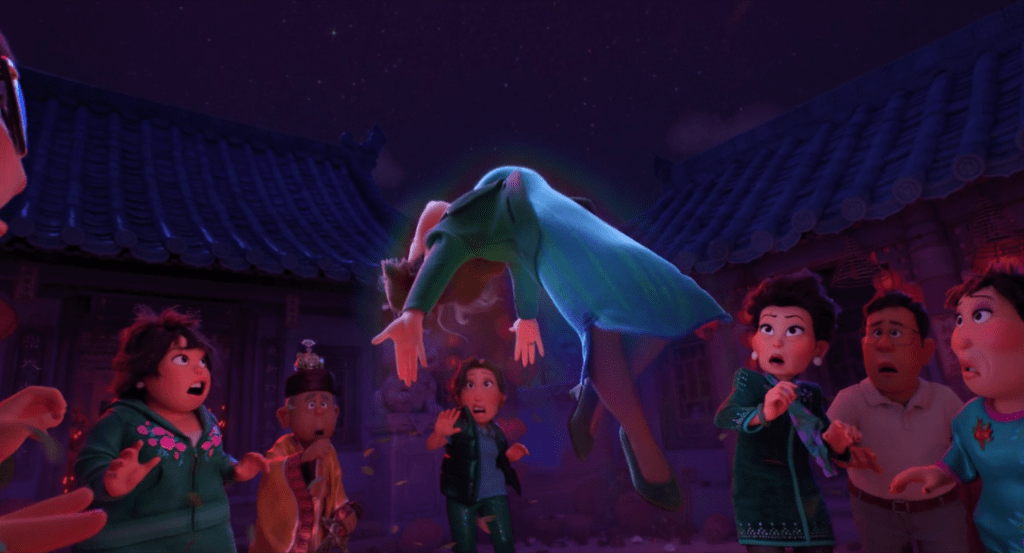
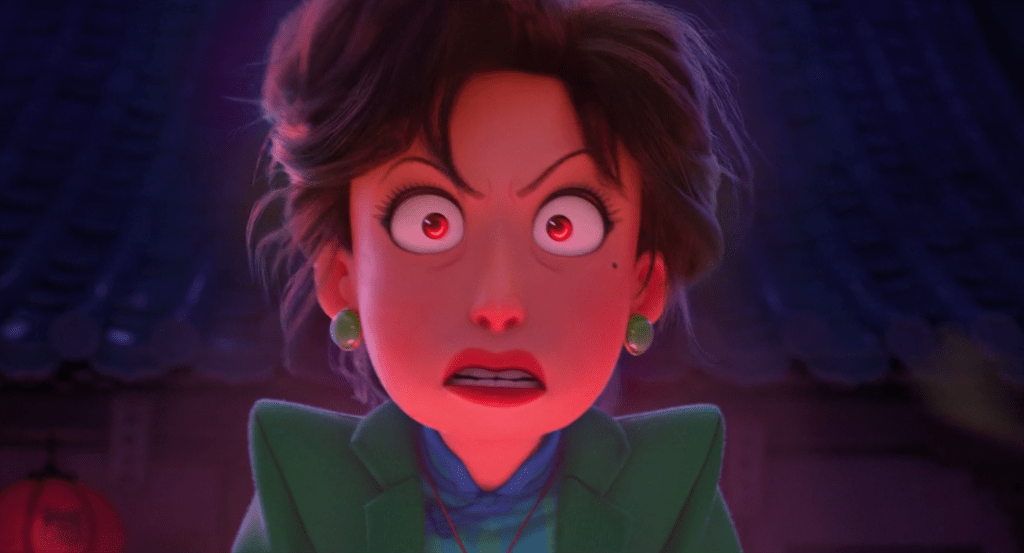
This is the part where the movie becomes both really cool and ridiculously funny. To give you a sense of what’s to come, Jin mentioned earlier that Ming’s panda was big. What he failed to mention was how big.
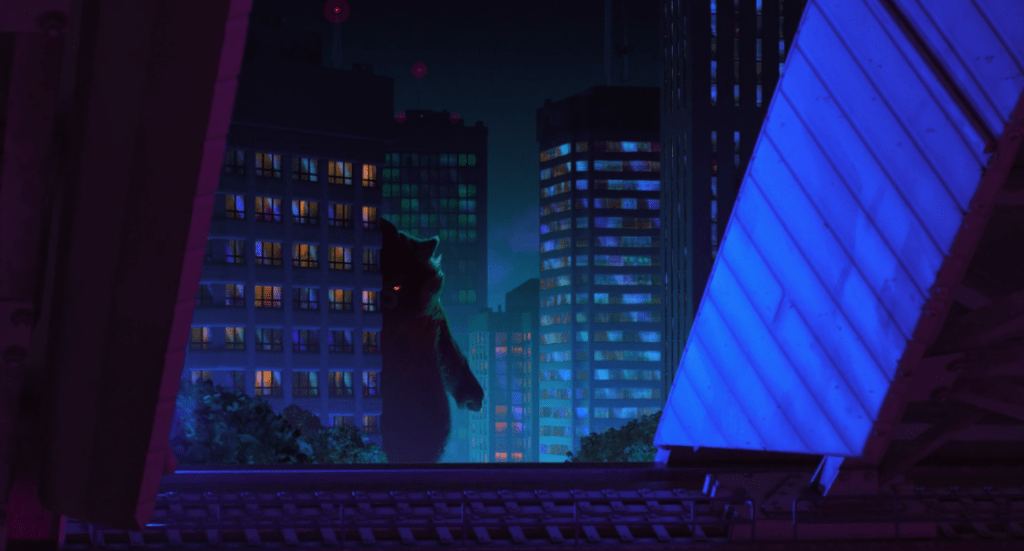
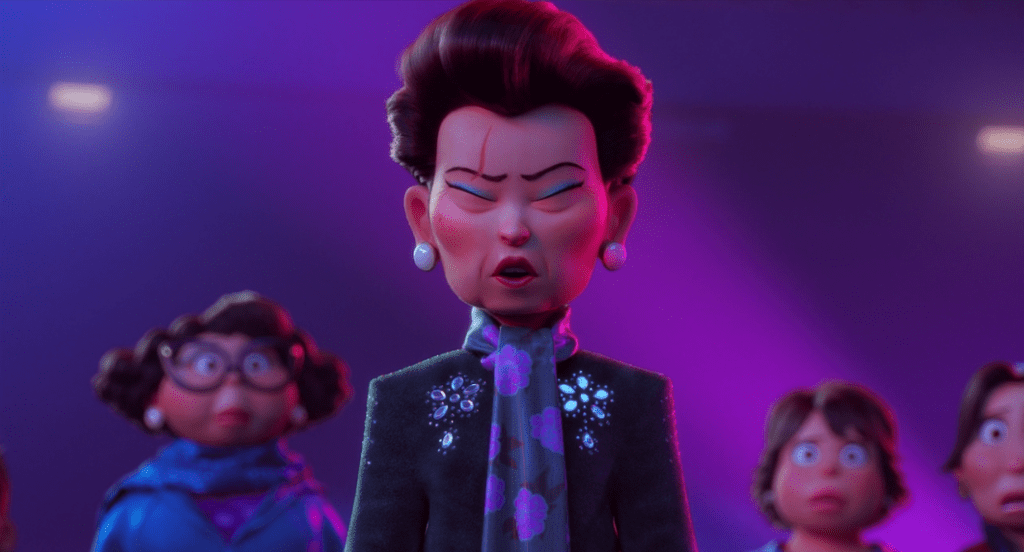
What I love most is that despite being a literal kaiju, she still retains all her mom qualities. She can’t sanction the inappropriate youth at the concert –

EVERYONE, GO HOME!

WHERE ARE YOUR PARENTS?!

PUT SOME CLOTHES ON!
– Mei-Mei’s in big trouble –

YOU ARE IN BIG TROUBLE YOUNG LADY!
– she takes bites from panda Mei like she just broke a nail –

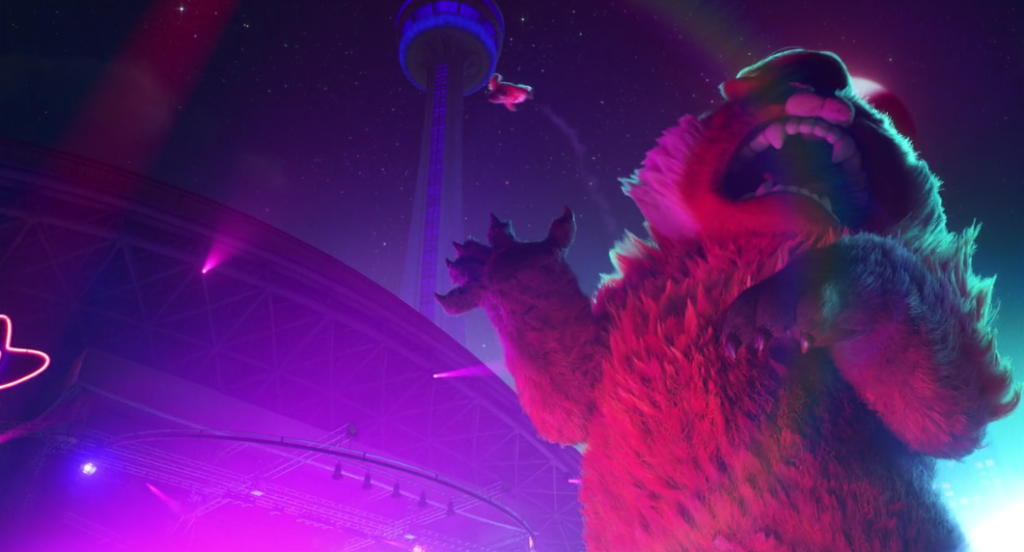
– her vocabulary is still on-point –

HOW COULD YOU BE SO, SO –
CRASS???!!!
– and she’s defeated by…twerking.

WHAT ARE YOU DOING?!

STOP MOVING LIKE THAT!!!
I’mma come out and say it: panda Ming is my favorite character. If Godzilla was a Ru Paul’s Drag Race contestant, this is what she would look like. What an absolute queen.
Also, this is the only time I’ll accept twerking in a kids film, because it actually makes sense. As a mom she can’t stand seeing her daughter act inappropriately, so the twerking actually has plot significance. That and it doesn’t last very long. What makes this scene even cooler is when Mei’s family unleash their pandas to save Ming from hers. It’s very heartfelt, cute and funny.

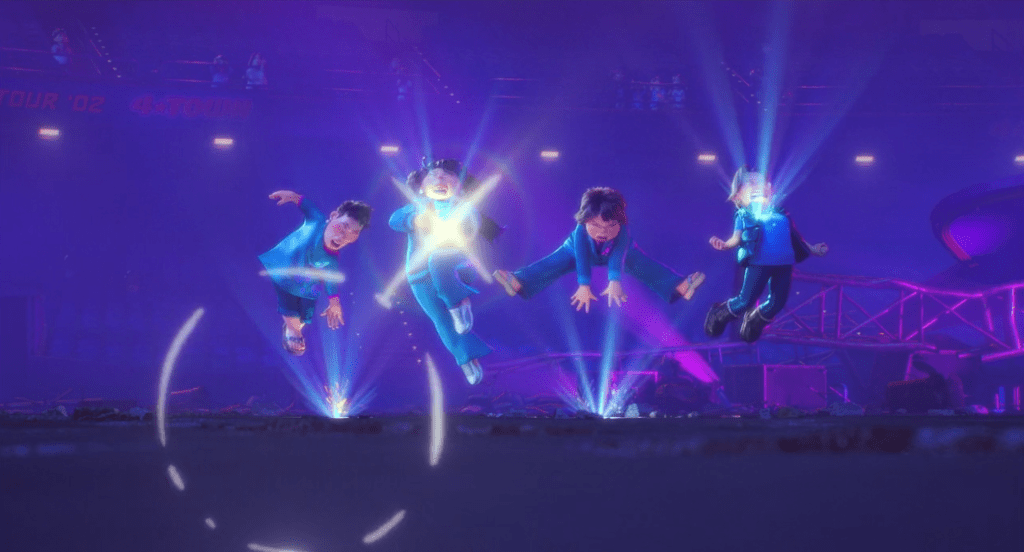

After this bit of fun, the movie gets more serious. It’s here that we also realize that the panda, in a way, has been a symbol of generational trauma. Because when they restart the ritual, this is how Mei finds her mom:
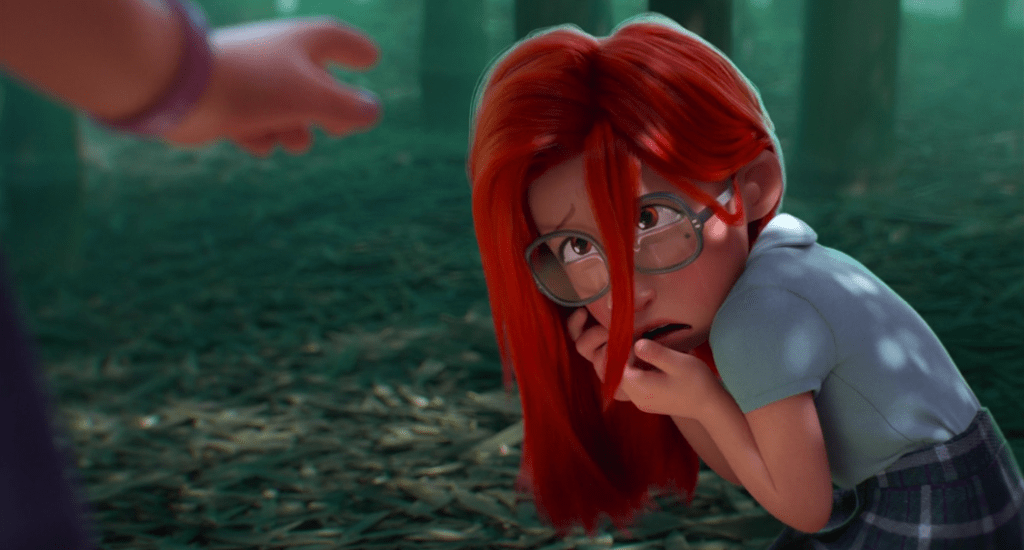
Young Ming explains how she lashed out at her mom, but that she didn’t mean to. It’s only because Ming’s negative emotions were so strong that they manifested in that city-destroying monster. She doesn’t know how to control it, but her outburst was so bad that her family sealed her panda. Hers and all her sisters’ pandas. This is also likely the reason why the family associates the panda with negativity and evil.
In the process, they lost sight of how every person is different and experiences change in their own way. In Ming’s case, sealing the panda was very necessary, but not in every case. It’s because of this trauma that Ming has been overprotective of Mei. Given her own childhood experiences, she doesn’t want the same thing that happened to her to happen to Mei. Although, she does end up learning the consequences of her actions.
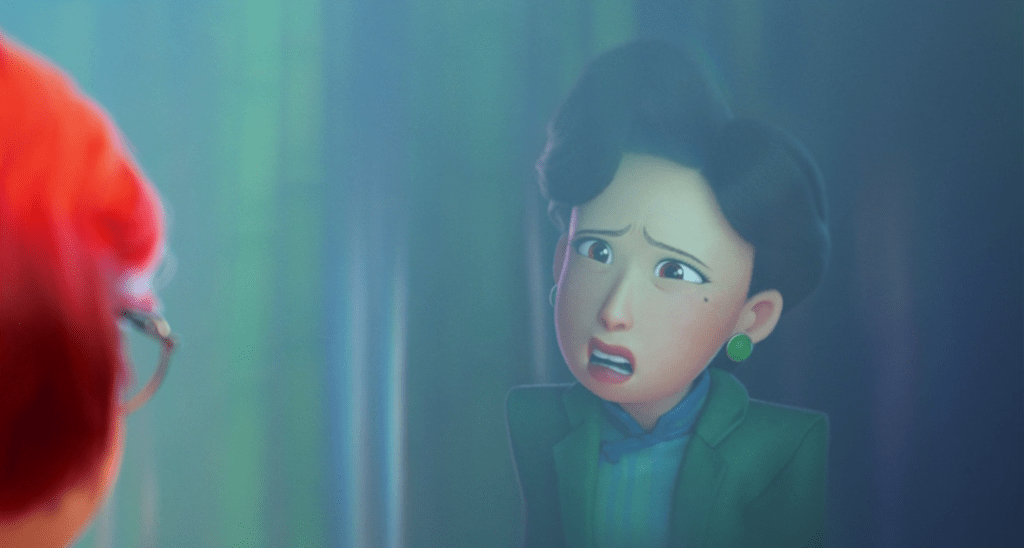
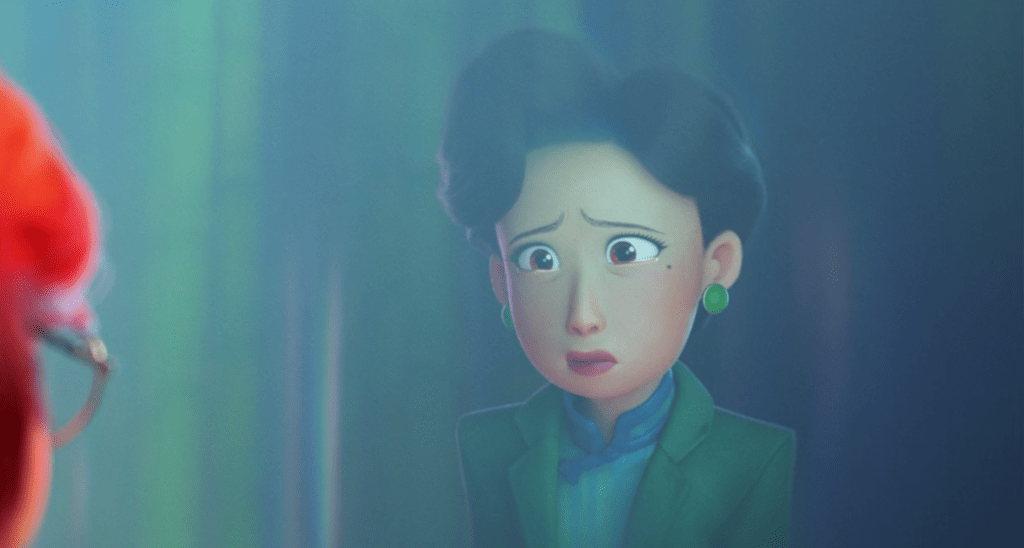
Neither of them want to drift apart from each other, but that’s part of life. Not that you stop loving your family as you age, but you love them in different ways. It’s just a normal part of growing up, because, as Remy said in Ratatouille:

And that’s essentially it. In the end, Mei keeps her panda as previously mentioned. I also like how when she makes that decision, she’s visited by the spirit of Sun Yee herself. It implies that she’ll always be there to lend her strength to Mei when she needs it.

…wait, what?
Mei spends more time with her friends while still helping out at the temple when needed.

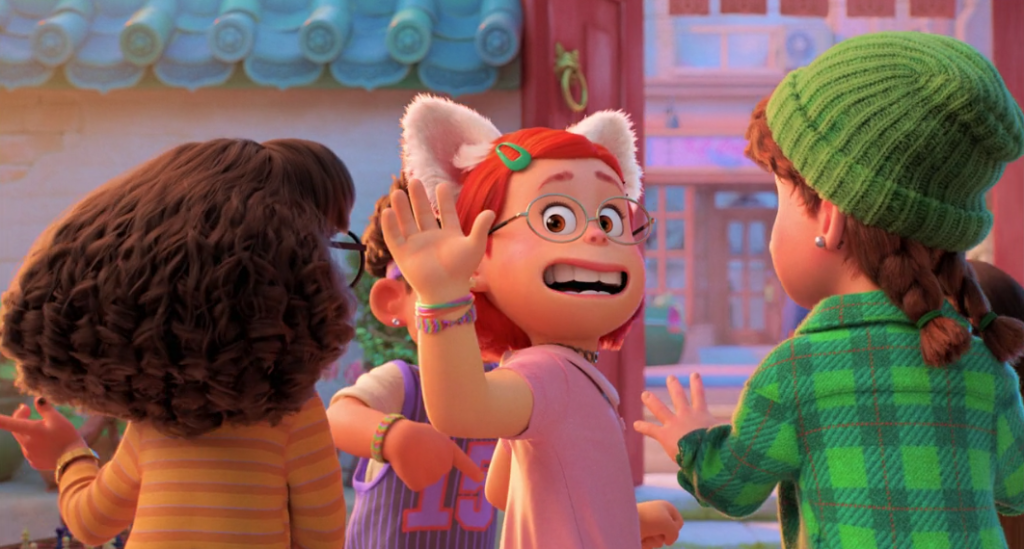
Everyone learns a valuable lesson and life is never better. Overall, I’d say I’m impressed by how this movie turned out. Particularly the personal connection it has with its characters which is harder to find in recent Pixar films. I feel inclined to be overwhelmingly positive about this movie, but I admit it’s not perfect. What film is? So I’ll wrap up my thoughts in the most objective way I can.
This movie basically adds up to Pixar’s version of Stand By Me or Lady Bird. For that reason, I refer back to my previous comment about the film’s originality. It manages to be its own thing through the red panda concept and family dynamics, but that’s about it. As far as “coming-of-age” films go, this one is still pretty standard. To be fair, with the “coming-of-age” genre, it’s difficult not to fall back into repeatable tropes.
An essential part of growing up is the changes you go through, whether they be emotional or panda-related. What, that never happen to y’all? Since I grew up looking like this:

Overall, my inner critic wants to be harsher on this movie, but I can’t bring myself to do it. I’m not sure why either. The only thing that legit bothered me in the movie is when Tyler showed up at the concert. I don’t mind that he’s embracing his interests, what I mind is his reaction to seeing Mei again.


He’s understandably embarrassed, but he warms up to the sight of Mei way too quickly. The reason I’m bothered by this is because the last time he saw her, this happened:
After something like that, I’d sooner believe he’d be in therapy before casually being within 20 ft. of Mei. Other than that, I can’t fault the movie for relying too heavily on “coming-of-age” tropes. What ties us to these stories isn’t the situations, but more so the characters’ reactions to those situations. Ultimately: we watch movies like this for the characters, not the unique scenarios.
In the end, it was a very enjoyable experience. Also, yes, I cried. What do you want from me? For films like this, I’m drawn to them due to the unique life lessons they each contain. Are some of them repeated? Sure, but the way they’re handled is what makes each film unique. Needless to say, this is a film I won’t be forgetting for a while. Pixar, you’ve done it again!
I’ve been struggling for a while on what I want to rate this movie. In the end, I’ll go with a 4.5/5 Momzillas. For a while I thought I’d do a 4, but after having that trope realization, I felt more forgiving. There are some things you just can’t help when it comes to certain genres. What matters more is the life you breathe into it with your own unique perspective and ideas. With that said, this movie does a pretty good job of that.
(I make no claim of ownership for any of the images used in this post)
(Each of them are owned entirely by their respective copyright holders, which are not me)
(I’m just a humble blogger who talks about movies, I do not make them)
(Props to these folks for a job well done, though)
 TGIMovies
Leave a comment